Competitor price monitoring: is AI enough?
AI can collect competitor prices in a few minutes today. That is genuinely useful, but ongoing competitor price monitoring (also called price tracking) is a slightly different task, and it is worth understanding how the two differ.
Botis CEO Marius Mačiūnas recently attended the Verskis client day. One of the most common questions there was whether a dedicated price monitoring system is still needed when an AI agent can visit a competitor’s website and collect prices on its own. In this article, we share what we see every day working with pricing data.
What AI does well
AI tools work well when you need data once or in small amounts:
- quickly checking what a product costs in a few stores;
- collecting a short list of prices into a spreadsheet;
- writing a simple script to scrape a single website.
If you need a market overview once a quarter, that may be all you need.
How ongoing monitoring is different
You can schedule an AI agent to collect prices every day and export them to a spreadsheet. That is a step towards ongoing monitoring, but it also makes you the builder and maintainer of a system. So it is worth weighing three things up front.
Price history
A one-off query shows what a product costs right now. For most decisions, though, what matters is how the price changes over time. An AI agent does not store history: each run returns only that day’s data. You can collect the exports yourself, but at larger volumes you need a database, a consistent data structure and a way to check that no day was missed. When history is collected properly, you can:
- see when competitors usually start promotions and how long they last;
- tell a temporary discount from a lasting price change;
- prepare for the season knowing how the market behaved last year, for example during Black Friday;
- base your pricing rules on data.
History cannot be collected retroactively, so it is worth starting before you need it.
Infrastructure
Collecting 20 prices once and collecting thousands of prices every day are different tasks. The second needs a system that runs on its own:
- Regularity – data is collected on a schedule.
- Scale – dozens of websites and thousands of products at once.
- Normalisation – prices with and without VAT, promotions and different pack sizes are turned into comparable data.
- Product matching – the same product has different names in different stores, so products have to be matched by EAN code and title.
- Quality control – if a website changes its design and prices suddenly disappear or become identical, this has to be caught immediately.
- Integrations – data has to reach your online store, pricing tool or reports.
A scheduled AI agent does not handle these tasks on its own. Each run costs money, it is slow across thousands of products, and results can vary in format or accuracy from day to day. That is why, at scale, AI is usually used as part of a system rather than instead of one.
This matters most when price data feeds dynamic pricing. If your prices change automatically based on competitor prices, every data error becomes a wrong price on your side. AI models sometimes hallucinate, producing a value that looks convincing but is wrong. Dynamic pricing needs accurate, verified data.
Website protection
Large online stores and marketplaces often limit automated data collection (web scraping). AI agents face the same restrictions as any other bot:
- after a few requests, a website may temporarily block access or show a CAPTCHA;
- a price sometimes loads only after a few seconds or depends on the region or selected variant;
- after a site redesign, scraping that worked yesterday may return empty data today.
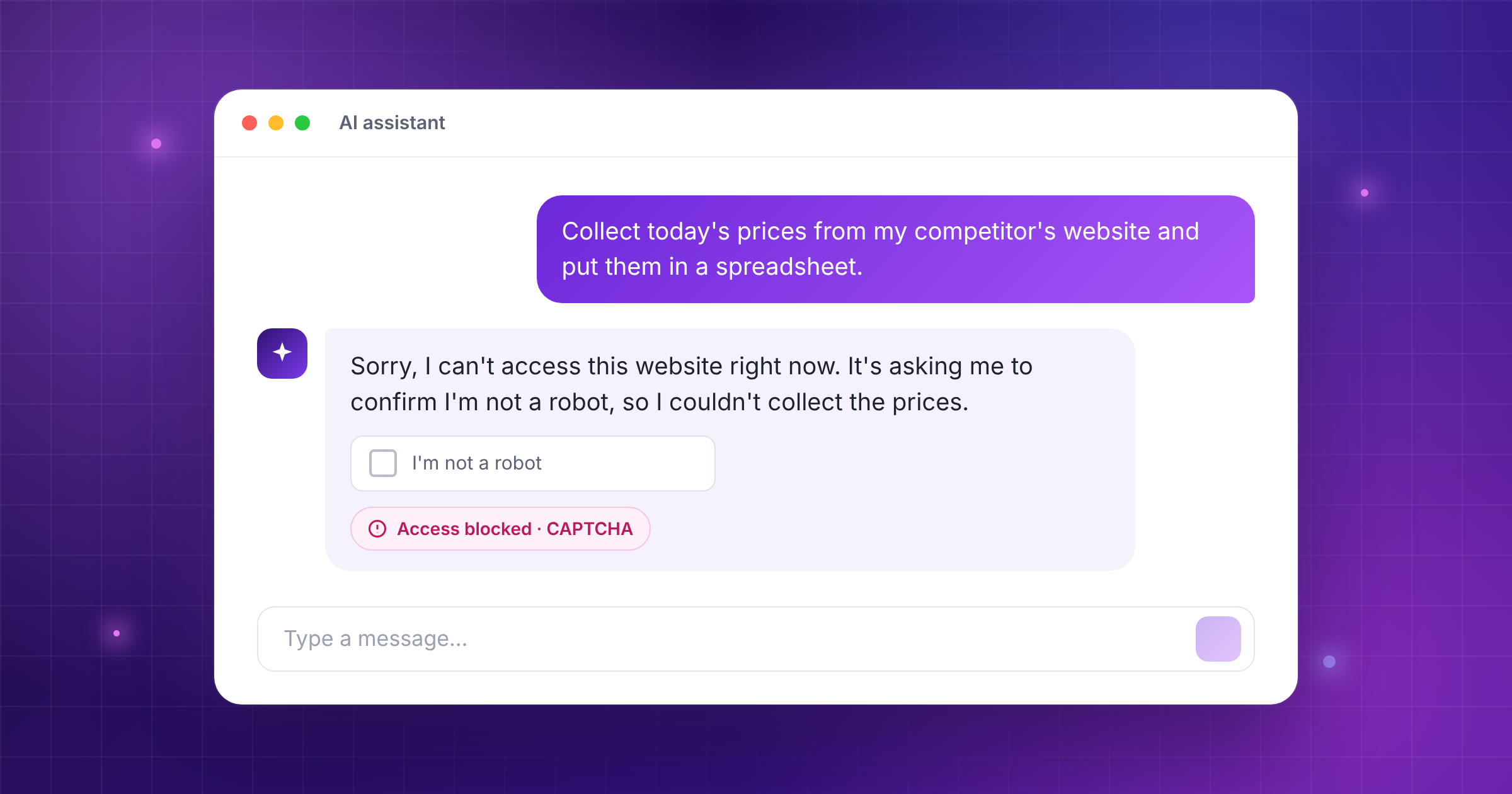
In these cases, getting data is not enough: you also need to know when it is inaccurate. That is why ongoing monitoring systems track blocks and errors separately.
AI assistant vs. price monitoring system: a comparison
| AI assistant | Price monitoring system | |
|---|---|---|
| When it collects data | When you ask, or as a scheduled task | Automatically, on a schedule |
| Price history | Not stored; you collect exports yourself | Collected daily |
| Scale | A few to a few dozen products | Thousands of products, dozens of websites |
| Protected websites | Not always successful | Blocks are monitored and handled |
| Error control | You check it yourself | Automatic alerts |
| Best for | Quick checks | Day-to-day pricing decisions |
How we use AI ourselves
The two approaches are not mutually exclusive. We use AI inside our price monitoring system:
- product matching – when price comparison sites have no shared product ID, AI helps find matches by EAN code and title;
- data quality checks – we are building an AI agent that regularly reviews projects and looks for anomalies: missing prices, suspiciously identical values, sources that have stopped working;
- data analysis – AI helps spot price trends and changes in competitor behaviour faster, and turn collected history into insights.
In our experience, AI works best as part of a system, not as a replacement for one.
Summary
If you only need prices occasionally, AI tools may be enough. If prices drive your day-to-day decisions, consider a system that collects history and runs reliably.
Botis builds and maintains competitor price monitoring systems, from data collection and product matching to integrations with your online store.
If you would like to discuss which option suits you, we would be happy to talk.